Information science · AI & Society · Digital inequality

Zhiyuan Lai

I study how people interpret, negotiate, and reshape digital technologies—and how those interactions reproduce or challenge social inequality.

Portrait of Zhiyuan Lai

Undergraduate researcher

Peking University

Information Management & Information Systems
Sociology (double major)

Technology is social before it is technical.

My work sits at the intersection of information science, sociology, and human-computer interaction. I ask not only whether a technology works, but how people understand it, what kinds of relationships it produces, and whose experiences its design makes visible.

I am particularly interested in digital inequality, human-AI trust, and the everyday information practices of communities that are often pushed to the margins. My current research examines gendered meanings in generative AI, AI disclosure and trust, rural women's use of short-video platforms, and the information practices of people living with HIV.

Since 2024, I have worked as a research assistant in Peking University's AI & Society Research Group under Dr. Pu Yan. I also conduct fieldwork-based qualitative research with Dr. Xingkun Liang and collaborate with Yunjie Tang on generative AI, gender, and LGBTQIA+ identity formation.

2023–2027

Peking University

B.M. in Information Management and Information Systems

B.A. in Sociology (double major)

Summer 2025

National Tsing Hua University

Visiting student; conducted a cross-cultural study of Taiwanese public attitudes toward generative AI with Prof. Tzu-Hua Wang.

Selected publications

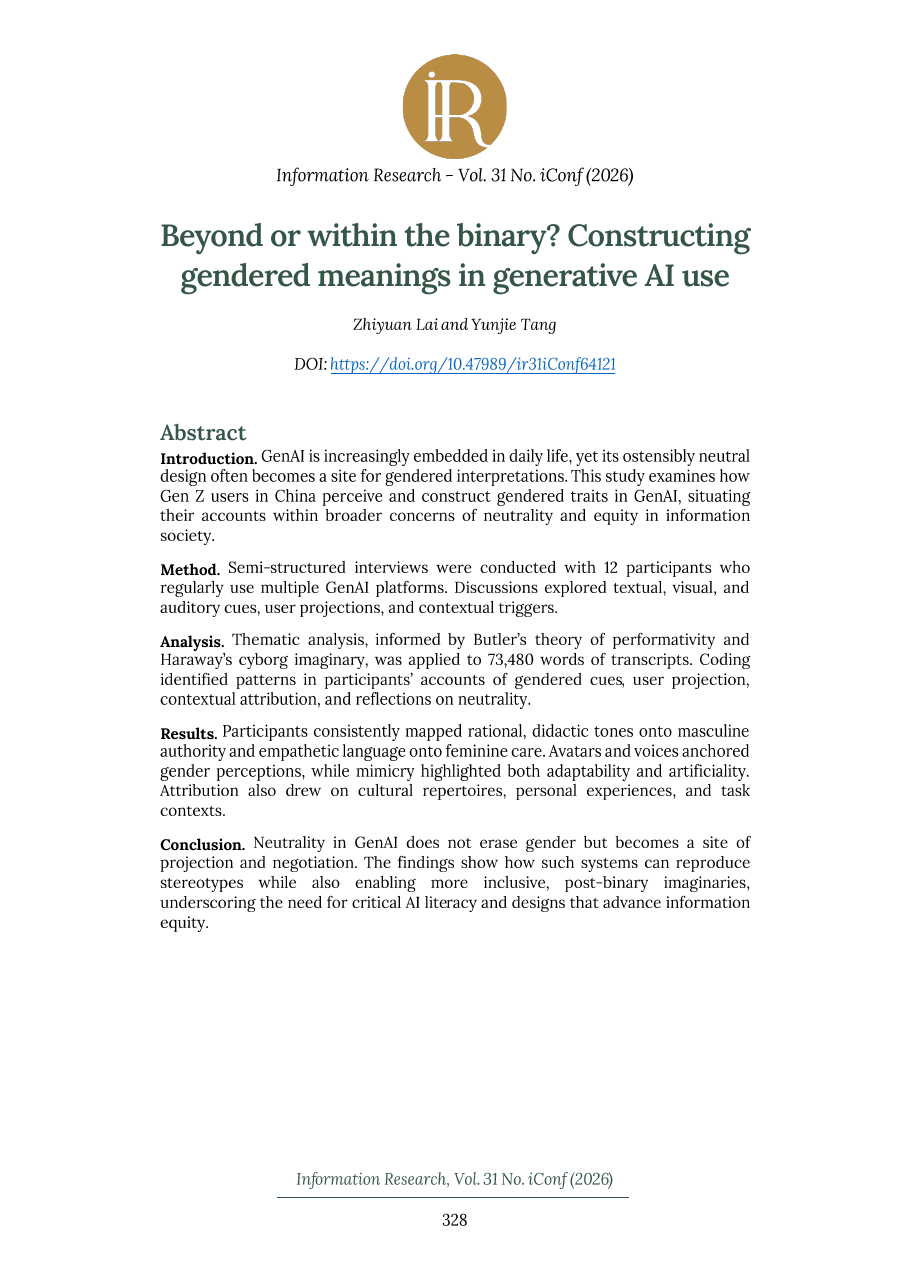
First page of Beyond or within the binary

iConference 2026Published

Beyond or within the binary? Constructing gendered meanings in generative AI use

Zhiyuan Lai and Yunjie Tang

Information Research, 31(iConf), 328–344

Drawing on interviews with 12 Gen Z users in China, this study shows how ostensibly gender-neutral GenAI acquires gender through language, voice, images, cultural expectations, and users' own projections. It shifts attention from bias as a property of the model to gender as a meaning co-constructed in interaction, revealing how AI can reproduce familiar stereotypes while also opening space for more inclusive, post-binary imaginaries.

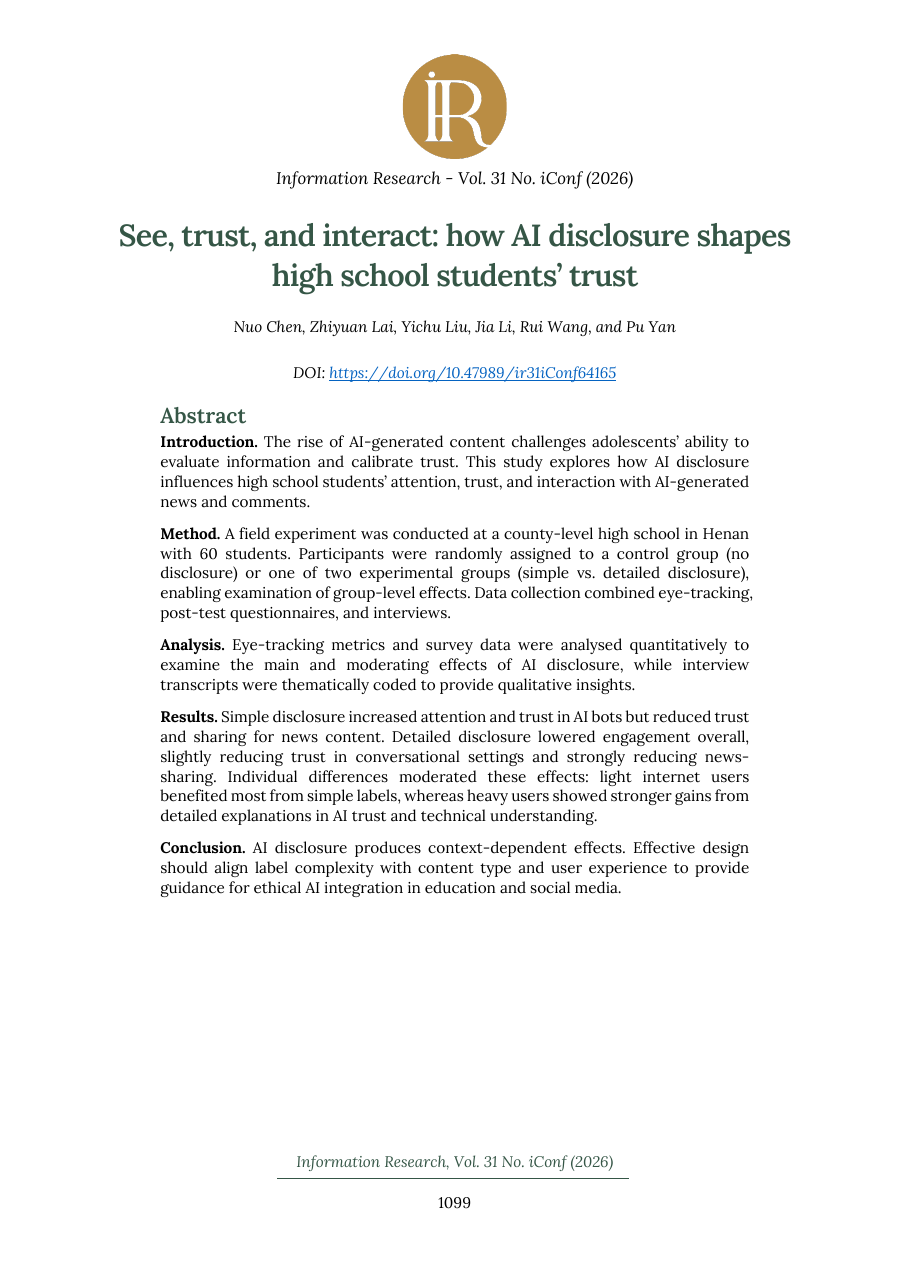
First page of See, trust, and interact

iConference 2026Published

See, trust, and interact: how AI disclosure shapes high school students' trust

Nuo Chen, Zhiyuan Lai, Yichu Liu, Jia Li, Rui Wang, and Pu Yan

Information Research, 31(iConf), 1099–1145

A field experiment with 60 students in a county-level high school combined eye tracking, questionnaires, and interviews. Simple AI labels increased trust in conversational bots but reduced trust and sharing for news, while detailed disclosure generally lowered engagement; these effects also varied with students' internet experience. The findings show that transparency is not one-size-fits-all and offer practical guidance for designing age- and context-sensitive AI disclosure.

Manuscript · Under review

Tang, Y., & Lai, Z. (Under Review). “Empowering LGBTQIA+ Identity Formation in China Through LLM-based Chatbots.” Journal of Information Science.

Manuscript · Under review

Lai, Z., Liang, X., Jiang, C., & Li, Z. (Under Review). “Lives of the infamous: Identity linkage potential and everyday information practices among people living with HIV.” ACM/IEEE-CS Joint Conference on Digital Libraries (JCDL).

Projects and fieldwork

AI & Society Research Group · Research Assistant

  • Conduct literature reviews and quantitative data analysis for a National Natural Science Foundation project on the factors and mechanisms shaping the algorithmic divide.
  • Support a Beijing Social Science Foundation study of algorithm literacy among Beijing residents by refining survey designs and analyzing data.

Public Trust and Attitudes toward Generative AI in China

  • Led a multi-stage mixed-methods study, developing and validating a localized GenAI Trust Scale across two large-scale surveys.
  • Designed a controlled eye-tracking experiment and analyzed eye-tracking and survey data in R, finding that simple AI labels increased trust in conversational contexts but decreased trust in news consumption.

Lives Under Stigma: Information Practices as a Survival Strategy

  • Conducted multi-site fieldwork at Beijing Ditan Hospital and the Beijing Red Ribbon Home using semi-structured interviews, participant observation, and online ethnography.
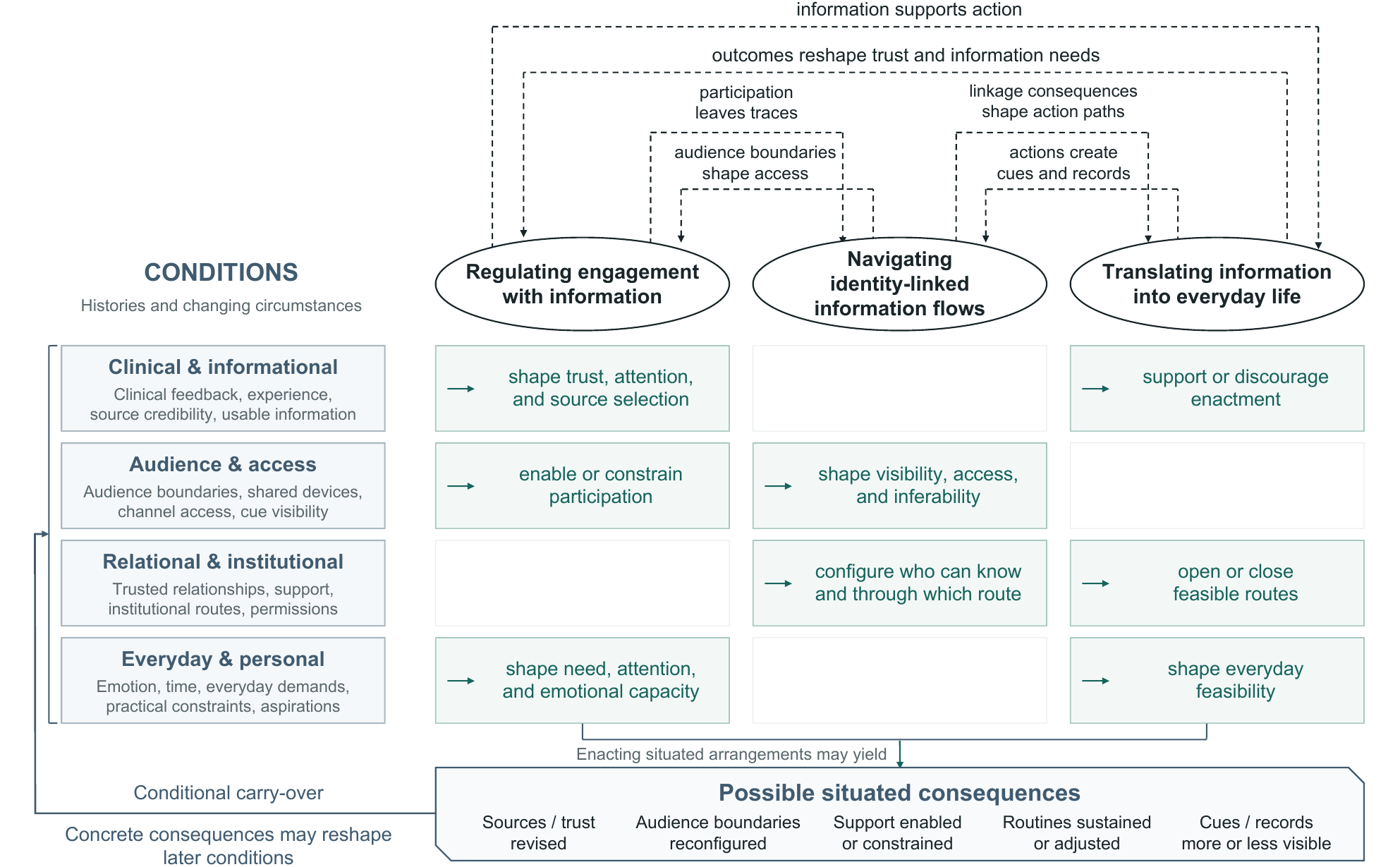
  • Developed a framework explaining how people living with HIV regulate information exposure, navigate identity-linking information flows, and translate information into sustainable everyday action; presented at the 2026 Annual Meeting of the Chinese Sociological Association.

Rural Windows on Screens: Self-Presentation and Social Interaction on Short-Video Platforms

  • Led a mixed-methods project combining ethnographic fieldwork in rural Hebei with computational social science methods, independently scraping and analyzing Douyin and Kuaishou comments in Python with BERTopic.
  • Framed short-video use as flexible resistance to social marginalization and a tool for community building; presented at the 2025 Annual Meeting of the Chinese Sociological Association.

Honors & awards

2025–2026Third Prize, 34th Peking University Challenge Cup
2024–2025Merit Student, Peking University
2024–2025National Encouragement Scholarship
2024–2025Second-Class Scholarship, Peking University
2024–2025First Prize, 33rd Peking University Challenge Cup
2023–2024Award for Academic Excellence & National Encouragement Scholarship